Proverbs 27:27 And thou shalt have goats' milk enough for thy food, for the food of thy household, and for the maintenance for thy maidens.
Showing posts with label Chickens. Show all posts

Saturday, January 28, 2017

2017 Winter Kid Crop!

I have wanted a blue eyed Nigerian Dwarf milker for a long time.  Silly, I know.   I have some really great milkers and animals on my property.  I am grateful.  None of my blue eyed goats, have ever made the cut as easy to hand milk.  They always give a wonderful amount of milk, by the grace of God and because of their excellent genetics but being able to comfortably hand milk a goat, is very high on my priority list.  I want the milking experience, for me, to be enjoyable, as well as for the goat.  I want to be able to go out to the barn, milk quickly and then spend time with my animals and family.

Carmel Pie is a first freshener this year.
Carmel Pies grandmother was Abundance (a blue eyed milker that didn't make the cut).  Carmel Pies mother was Jubilee (a blue eyed milker that didn't make the cut either.)  Every year, I bred these blue eyed does to wonderful bucks, hoping these bucks genetics would improve on their teat length and diameter.  So...Carmel Pies first freshening was really exciting for me.  She did a great job carrying and delivering her babies.  She delivered on the 23rd and had a beautiful, big, black and white buck and a tiny, white, speckled, doe with blue eyes. 
Doe and Buck.
Doe.
It has been years since I have let a goat keep her babies and nurse them.  It has been nice to watch them all together.
Kinsley and the doeling.

Carmel Pie is giving a wonderful amount of milk for a first freshener but her teat size is not comfortable to milk on.  Even though I know they will lengthen some through regular  milking, it will not be enough to hold up to my strict standards.  I not only like easy to hand milk does for me and the genetics for it, in my herd but my customers, who buy goats from me, usually hand milk and would like that in the offspring they purchase from me.

I have decided to give up on improving this blue eyed line for hand milking and sell Carmel Pie.   Since I will be selling Carmel Pie and her babies, I decided to let her keep her babies (not take them away and bottle feed them) and sell them as a package deal.  I will miss her as she is very sweet and stunning with her ice blue eyes.

I will be purchasing a blue eyed Nigerian Dwarf doe, already in milk in the future.

The other goat that was pregnant was Calfy. 

She delivered January 24th. She gave me triplets, two beautiful bucks and a doeling. 
The little brown doe and white buckling.
The other buckling.
They are healthy and are 3/4 Nigerian Dwarf.  Joseph is their dad.  Calfy is doing well and milking up a storm.  I pulled the babies and they are nursing (bottle feeding) well.  I will be dehorning all the babies tomorrow and then selling them.  I have a waiting list of people wanting goats so they should be gone quickly.

I bred Panda to Joseph last week, when I saw she was in heat.  Pandas mother, Milky Whey, came into heat a week later.  She is in with Joseph now.  We should have babies from those breeding in five months.  Very exciting.

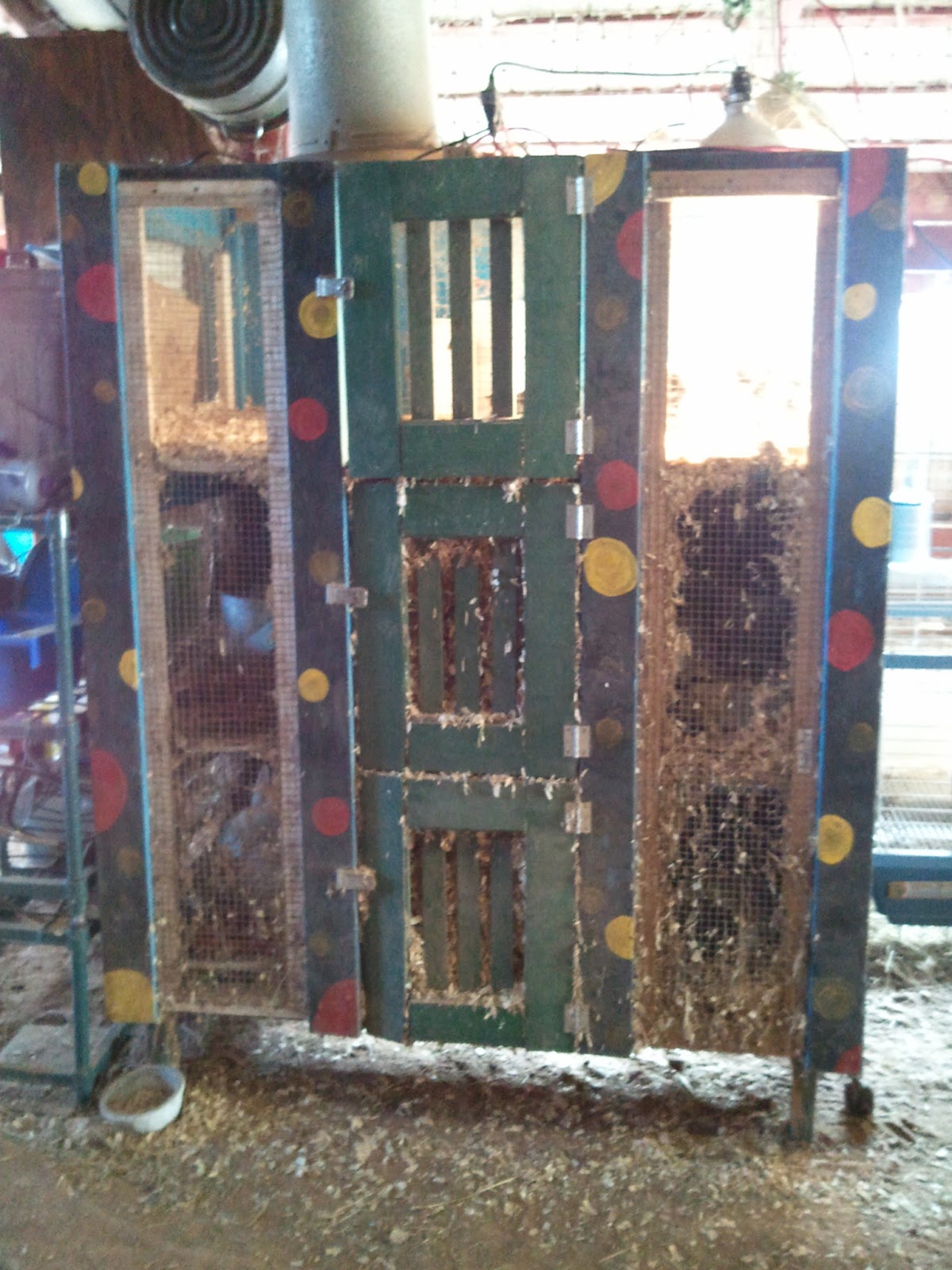
In another area of news on the farm, with the help of God and some of my children, we built my five year old son the chicken coop he had been wanting for his bantam chickens. 
We had a two week warm spell here in North Georgia, so I worked on it every spare moment, trying to get it done before the weather turned cold again.
I built it so a five year old could care for chickens with minimal adult help.   There are three different compartments to keep breeds separate.
Each area had two next boxes, a roosting bar and a feeder.
I found how to make these small feeders on the internet.
My dad had the brilliant idea of putting self closing foundation vents on it for ventilation.  I wont need to be going out to open and close air vents all the time.  :)

My son is very excited and happy with his new coop.  Praise God it did come out very well.  :)

Philippians 4:19  But my God shall supply all your need according to his riches in glory by Christ Jesus.


Blessings and Happy Farming,

susan  

Wednesday, September 4, 2013

September

Wow, so hard to believe it is September already.  I am finally exhaling after the business of gardens, chicks to be raised and baby goats to bottle feed and wean.  The over flow of veggies and milk has really kept me hopping.

The last few weeks have been almost like a vacation since the garden finished up.  I decided not to plant a fall garden as I have so many things on my list to do this fall like washing the whole outside of the house and scrapping and painting trim.  I have grapes vines that need alot of attention and fences that need fixing and tightening up.  That is just some of it... I didn't think I would be a good gardener and keep up with it all with all my projects to do before winter.  So maintenance is going to have to do in that area. :)  The normal cleaning out the garden beds and working in some manure.

I have been working at drying off my two full sized milk goats and do not have plans to re-breed them again.  They are my dads favorites from our full sized goat herd we used to have.  The only two we have left from that herd so he wants to keep them.  So they will be retired as pasture ornaments as soon as they are both dried off well.

I am going to be breeding Amelia (one of the mid-sized goats born this past spring) to Joseph this month if she comes into heat.  She will give me my spring milk for next year.  She is a good size so will do fine and Joseph gave some really nice babies his first time around as breeder buck on the farm, so am excited to use him again and see what we get!

Also I will be breeding one of my Nigerian Dwarfs this month as well. (Milky Whey or Plenty) I have just not chosen who yet.  Both are in full milk production and will be very hard to dry off. I would love a daughter out of either of them.  I kept a buck from each of them this year.  They are gorgeous and will be great breeders for me now that I have seen and milked both their moms.  Top notch for back yard hand milking. 

I have Abundance advertised for sale and have already given away one of her bucklings.  The other one is spoken for and will be going to his new home once he hits three months old.  I have found homes for all the bucklings I am not keeping.  The whole kid crop this year were all beautiful.  I had no trouble finding them all homes.  Here's just a few we have left.

Milky Whey's full production udder looks like this.

She has a very nice udder and longish teats.  She is easy to milk and gives a lot for a Nigerian.

Plenty's full production udder looks like this.

She has a huge udder that empties completelys.  She also gives a lot of milk.  Her teats are a bit shorter but she is still very easy to milk.  I can see that making the shift to these smaller goats was a very good thing for my family.  They will still give us plenty of good fresh milk for our needs with out the hassle of all the abundance of milk that we had to find uses for before.  I don't like waste. 

If I freshen one mid-sized goat and one Nigerian Dwarf every six months I will always have enough milk and some to spare for cheese making.  Now that I have had the smaller sized Nigerian Dwarfs (herd) for a year...I can see they do indeed eat a lot less and give more milk per amount of food eaten.  Also, I usually bought at least 120 bales of Bermuda square bales each year for the goats.  I still have half a haymow full and it is time to buy again.  So they eat about half as much hay. (and I feed hay year round if they want it)  I have been very pleased so far with all the changes we have made here, moving from full sized goats to the smaller ones.

Also our freezer roosters are growing really well.  They are almost to butchering size.  They should be ready for freezer camp around October 1st.  Murry Mcmurry sure sent us some pretty ones in this assortment this year. 
I pray all is well with everyone!  Blessings and Happy Farming!
susan

Saturday, August 3, 2013

Busy Week On the Farm

Living on a small farm can be very busy.  Sometimes, I feel like we just never have an extra moment at certain times of the year.  This is one of those busy times of year.  I not only have our twice daily milking and normal barn chores but baby goats to bottle feed and the garden.  The garden is a wonderful thing to have and we love having it.  It saves us a lot of money and is healthy eating for little monitary cost.  Only hard work. :)


But when things are ripe they are ripe and we better either eat them, preserve them or make them into something and it can't wait.  So a "not so busy week" can quickly turn into a busy one.  Some years certain plants will do better than others and over produce.  Last year it was green beans.  We were over run.   We ate them about every way you can think of.  Daily.  They were good but by the end of the season we were pretty green beaned out.  :)  The deer got ALL of the green beans this year.  So from  year to year you just never know how much of anything you will get.

This year it is tomatoes and peppers.  We have been blessed with an absolute abundance of them.  They are on plates and in bowls all over the kitchen.  I got smarter this year and bought a lot of those two and three tier plate racks at thrift stores and so am now going up with our produce to take up less counter space.
We have made two small batches of Chili Sauce with the extras, so as not to waste anything.
Needless to say the family has eaten a lot of tomato dishes and tomato sandwiches.  They have also eaten a lot of peppers different ways.  Praise God the uses for tomatoes and peppers are just endless.  From spaghetti sauce to salsa.

We also had to butcher five chickens on Monday.  I will spare you the intricate details of butchering but show our "butchering set up" for the curious back yard farmers that are thinking about doing it and don't have the nerve yet.  If this little country wife and a few kids can do it you can too.  Our set up is efficient but not expensive or fancy.  When I needed to learn how I "googled" it.  Read tons of ways to do it and did what made the best sense to me.   I am not going to be showing terribly gory pictures below but if the thought of butchering and seeing the equipment will make you feel bad or uncomfortable you might want to skip the rest of this post.  :)  Blessings!

William is my squeemish young man, so his job is to heat the water up to the right temperature (145-160 works best for us) and bring it out to us when we need it.  He also does the final washing off and picks out any small pin feathers once the bird is pretty much clean before I wrap them in plastic wrap and bag them in freezer bags.

Above is our scalding pot.It is just an old large water bath canning pot.  It was left here in a pile of junk by the old owners of this property 14 years ago.  It has been very useful.

 Above is my fancy butchering set up.  My killing cone is a large plastic white vinegar bottle (bottom and top cut out) screwed to the wall with a garbage bag under it.  My non-porous table that is easy to wipe down and keep clean.  A trash can.  A clean large bowl for carrying the clean birds up to the house for William to do a final go over.  A bottle of vinegar and water  and paper towels for quick clean ups.  My knife and sharpener and a pair of kitchen scissors.  The bale of chips is just to hold my bowl this time.  :)

These two ropes hanging down is where we pluck from.
Seriously, this is all you need except for a chicken/rooster of course and some running water, plastic wrap and freezer bags.  Not to hard or bad really.

I never wanted to start to butcher our own food.  It took me becoming knowledgeable about what happens to our food and how it is handled.  How many chemicals and things go into everything and also a health crisis to make me realize we had to do this to have pure food.  I have an auto-immune disease that requires me to eat food that is not sprayed or contaminated in any way.  I have to know what is done to the food I eat or I have horrible symptoms that make my quality of life not very good.  So I am grateful that I have learned this skill and live where I am able to raise some chickens/roosters to do this.  We give our birds the best and happiest chickeny life they could have. 


We feed them well.  We treat them with great care and they lack for nothing.  They have a purpose and are valued.  We are grateful to God for them and butcher them in the most humane way we can.  That's my two cents on it all.  :)


We sent three of the five birds to freezer camp after a rest in the fridge. But the kids excitedly slotted the two biggest ones for being bar-b-q'ed  for movie night this week.
William and Carolyn love to cook together and made their movie night meal.  They had chips and other stuff with it too.


God is so good to us always.  I am grateful for all He helps us do and get done around here.  For all He has shown us how to do.  It really is a wonderful way to live. 

Gods many blessings and Happy Farming!
susan


Tuesday, July 30, 2013

Roosters Are Growing and Crowing!

Every year I get some cheap heavy breed roosters to raise and butcher to put up in the freezer.  One of my favorite things about buying the heavy breed rooster special is you never know what you are going to get.  They just grab from the left over heavy breed roosters boxes for the day and ship them.


This year I got a lovely assortment of all kinds.

I love watching them grow up and mature.  They are so beautiful as they get all their lovely tail feathers and start crowing.  All of them so pretty except for the Naked Necks!(Tukens)

Having so many roosters practicing their crowing is very interesting in the mornings.  :)  I did notice we had a a few hens in this batch this year.  I will pull those out and find them homes.

I pray all your farming adventures are going well this year!

blessings and happy farming!
susan


Saturday, April 13, 2013

Chicks 5 1/2 Weeks

      Our spring 2013,  5 1/2 week old, White leghorn pullets.(there are a few commercial blacks too)

                   The same white leghorn chicks when they were one day old.

Well, those sweet, cute and fuzzy babies have grown into fully feathered young pullets.  They now look like mini versions of their adult counterparts.  I always enjoy watching them grow and change from week to week.  They truly develop right before our eyes.  Spring would not be spring around here without baby goats, baby chicks and small, bright, green garden seedlings.

As many of you know we started out with our chicks in the brooder.

Then to the grow out pens that I built out of PVC and hardware mesh.

I have been watching them alot lately and noticed that they are not staying under the light anymore hardly at all.  Even with the cooler night temperatures.  I also see they are getting a bit over crowded.
 So it is time to move them to the next step up here on the farm and that is into a barn stall.  I have a barn stall with a secure outside access.  The perimeter fencing is chain link.  Right now these chicks could squeeze thru the chain link but I put them in this stall so that in a few weeks when they are a bit bigger I can let them outside during the day and shut them in at night.
                     Carolyn spreading pine chips for the young pullets.
Carolyn helps me alot in all I do.  She is going to be a wonderful wife someday for someone.  She is a hard worker and since she is by my side helping me so often, she knows how to do a lot.  She is the best of all my children at gently catching chickens, geese and ducks!  She loves animals.
 White leghorn pullet,My beautiful daughter, Commercial black pullet.
             Very happy pullets with a new clean stall and alot more room!


Psalms 3:3  But thou, O Lord, art a shield for me; my glory, and the lifter up of mine head.

Blessings, 
susan


Thursday, March 28, 2013

Save the Chicks!


This time of year when we go into the farm stores for our grain or to browse the isles to start to plan our gardens we hear it almost as soon as we walk in the store.  The peep, peep, peep of tiny, cute, fuzzy baby chicks.  I always say I am not going to even look.  I do raise a batch of layer chicks for eggs and roosters for meat every year.  So why look.  I always have plenty of chicks around in spring to raise and get my fix.  But eventually, either one of the kids drags me over  to look at them or I happen by the area and glance down and am hooked to look.  I look at all the kinds they have.  Look at all the differences.  Look into the mixed pen to try to see if I can guess what kinds the different chicks are.  Then there are the easter pens.  Full of fluffy yellow chicks and little yellow ducklings and I hate to say this but many in those pens are doomed to be bought by so many well intentioned people, who buy just one or two chicks or ducklings for their kids for easter and might not know how to care for them. 
             Sound asleep in the chicken feeder after eating its fill.  That is the life!


Most people don’t realize that ducklings are INCREDIBLY messy and the chicks they bought most likely will not be pullets that will be egg layers once grown.   I mean I am just as guilty of impulse buying.  Just happened to me about two weeks ago.  I already had my batch of pullet layer chicks going here on the farm and while at the farm store saw some little Americana pullets.  You know, the ones that look like little chipmunks with the stripes down their backs.  To cute.  Yup, you guessed it.  I bought three to bring home and watch grow up.  I would not have done it though if they were not exactly the same size as the ones I had going.  So there would be no picking on each other.  (And I know most people would think of that as a no-no too.  The germ factor of mixing different hatchings of chicks from different places.)

Anyways, I know anyone at anytime can google chick care or duckling care and get some very good information.  But I thought I would cover it lightly here today in case any one finds themselves trying to raise a few chicks or ducklings for their kids for the easter holiday and have never raised any before.  Or were gifted someone else's purchase because they didn’t understand what it took to raise a duckling or chick.

Now this description is not scientific or exact.  With temperatures and everything.  I mean, I have read some of the how to raise a chick websites and it is… keep them at this certain temperature with this much humidity and lower the temperature so many degrees every week till fledged and such.  I don’t have time for that kind of detail on our farm.  So this is what works for us.  Try it at your own risk.  Praise God I have never lost a batch yet. 

I have a three shelved brooder I built years ago. (above)  But if you have just a few chicks you can brood them in a homemade brooder of four short pieces of plywood screwed together, Some people use corrugated cardboard to keep them corralled in a small portion of a large stall until they are big enough to enjoy the whole stall or even a large rubber maid tote will work well.  I used large totes for years, they work great.  The tote meets several of the requirements they need.  They need a large enough area to move around freely, with a heat lamp on one end.  (Do not use the solid lid that comes with the tote, chicks need good air circulation!)The area needs to be large enough that they can get under the lamp when they get cold or move away from the lamp when they get to warm.  Chicks need to stay dry.  So bedding that is fluffy and easy to change out and keep dry is great like pine shavings.  Not cedar. Also, you might have to keep in mind predators.  So a screen top (hardware mesh, maybe) of some sort if you have cats or what have you.  Housing for brooding is basically a draft proof, predator proof pen with absorbent bedding with a heat lamp at one end.  The pen being big enough that the chicks can move away from the light if they get to hot.  Many people use the red heat lamps as they say it cuts down on them picking on each other.   But they come in white heat lamps as well.  I know this is not the right way to do it.  But the heat lamps have such thin glass if water gets splashed on them they crack.  I use old fashioned flood lights. (not the florescent ones as they give off so little heat) The old fashioned flood lamps last longer, are heavy duty and thick glassed.  Just keep in mind old style flood lights  don’t give off as much heat as an actual heat lamp.  So you might need to use two or hang it a bit lower.  I like to use two lamps if I am raising more than 20 chicks.  As if one blows there is another to keep them kinda warm till I see what happened.

Our 3 1/2 week old chicks are in my grow out pen I made now.  I just block the drafts with something flat.Note the feeders.

Eventually, you will have to move them to a bigger and bigger arrangement to accommodate their growth.  As overcrowding is a huge killer of chicks.  It causes pecking and it is hard to keep them clean and dry. At about four or five weeks old they should have all their feathers and you can start to decide if they need the heat lamp anymore.  Taking into consideration night temps and such.  Just pay attention to how often and when they use the heat source anymore. Often at this stage if we are having warm days and cool nights I keep the lamp on at night and turn it off late morning for the day.
Our three and a half week old chicks.  They are very awkward at this stage.  Half fluff and half new feathers.

Now what to feed them.  I recently had a neighbor raise a batch of chicks his broody hen hatched this winter.  He brooded them for four weeks and had no place to grow them out. So sent them to my house for the time it took to grow them out and I sent them back to his place.  He didn’t want to buy chick starter for them.  So just crushed up layer pellets and fed them out on that the first four weeks.  I had never done this in an experiment or anything but was amazed at the results.  Those chickens, even though they had layer mash for only the first four weeks of their lives were the most unhealthy misshapen chickens.  Bless their hearts.  Once they got to my house I raised them the rest of the time on chick starter but the damage was done.  Layer mash is 16% protein and a lot of research has went into what layers need.  Chick starter is usually 20% protein for their fast growing little bodies.  I guess what I am saying is don’t skimp and forgo the chick starter.  I never realized it but it does make a huge difference.  Out of seven birds only two are left alive now.  And they are not as robust or large as other birds raised correctly their age. 

So you need fresh water for them in a special chick waterer.  So they don’t drown.  And chickstarter crumbles.  Don’t let the food or water run out.  As they sleep and eat and sleep and eat.  They aren’t like a dog you feed just once or twice a day.  If you buy any chicks mail order I usually have to teach them to eat and drink.  As they got shipped the day they hatched.  Out of the shell, into a box and shipped to you and then out of the box at your home.  As I take each chick out of the box I dip each chicks beak in the waterer and set them down next to it.  If they run off that is fine.  At least they know there is water and where it is.  Usually a smart chick will come back and start to drink and lead the others.  To teach them to eat, even though you have a feeder in there,  I take a piece of paper towel and lay it in the bottom of the brooder.  Than take a pinch of chickstarter and slowly drop a little piece here or there on the paper towel.  The instincts that God gave them to go after bugs and movement kicks in and a smart one will run over and peck at and eat up the small crumble that just hit the paper towel and bounced like a bug hopping.  I do this for a short while and spread a little chick starter over the paper towel and leave it there for about 30 minutes for them to learn to eat and peck at the food without it sinking below the fluff of the pen.  I don’t leave the paper towel in there as news paper and paper towels are a bit slippery compared to fluff and raising chicks on it can lead to leg disfigurement called spraddle leg or splayed legs. 

Now when raising a duckling the above is pretty much the same, except for a duckling needs a lot of water to drink.  The food and water need to be close together as they eat and then wash it down with water.  They need a wide rimmed water as they kinda swish their little bills back and forth in the water to clean out their bills and drink.  With ducklings there is just going to be more mess.  More changing fluff because of all the water and wetter droppings.  They do not need a pan of water to swim in!  They can drown easily or get chilled if allowed to swim to young and not get dried off well.  I never let mine play in any water till about two weeks old and not in their pens unsupervised.  If is it a sunny after noon I will take them on a little field trip out side in the sun, let them play in a small low pan of water.... supervised... for a short time and then dry them off really well and get them back to the heat source.  When they don’t need the heat source anymore they are good to go on swimming and playing in water.  But I have still seen people do it to soon and one drown here or there or get chilled. 

Anyways, I covered as much as I can think of and if you have any questions feel free to email them to me.  I don’t know everything and there is great info…professional info.. out there on the web.  But if I can answer any questions I would be glad to. 

Gods blessings and happy farming!
susan